
Blog
Samsung Galaxy S26 Series: What YOU Need To Know


Samsung Galaxy S26 Series: The Wait is Nearly Over – Here’s Everything You Need to Know
But here we are in late January 2026, mere weeks away from the Galaxy S26 series unveiling, and something feels different this time. Not because the leaks have dried up—quite the opposite. Rather, it’s what they’re revealing that’s genuinely intriguing.
Samsung appears to be making moves that range from the overdue to the genuinely innovative. And for those of us in the UK, there are some particularly interesting implications about what will actually land in our hands come March.
⏰ Key Dates for Your Diary
25th February 2026: Galaxy Unpacked event in San Francisco (7pm GMT)
26th February 2026: Pre-orders open
11th March 2026: General release across UK, Europe, and major markets
The Launch That Nearly Wasn’t (On Time)
Let’s address the elephant in the room first. The Galaxy S26 series is launching late. Unusually late.
Samsung has built a January tradition with its Galaxy S launches. The S25 series dropped on 22nd January 2025. The S24 arrived on 31st January 2024. Going back further, the S23 launched on 17th February 2023. You see the pattern.
Now? We’re looking at a 25th February announcement and an 11th March retail launch. That’s the latest Galaxy S release since the Galaxy S20 hit shelves on 13th March 2020—and we all remember what was happening in March 2020.
The culprit, according to multiple sources, was indecision at Samsung HQ. The company reportedly scrapped plans for a “Galaxy S26 Edge” model late in development, reviving the Plus model instead. Model numbers tell the story: the S26 Plus carries the designation SM-S946, rather than the SM-S936 it should have inherited from the S25 Plus. That seemingly minor discrepancy represents months of behind-the-scenes chaos.
But delays breed anticipation. And Samsung seems to have used the extra time rather productively.
The Three Phones (And What They Actually Offer)
The Galaxy S26 line-up consists of three models: the standard S26, the S26 Plus, and the S26 Ultra. No Edge. No Pro. Just the core trio that Samsung believes will cover the spectrum from “flagship on a budget” to “money is no object.”
📱 UK Pricing (Projected)
Galaxy S26: Starting from £799 (128GB/256GB models)
Galaxy S26 Plus: £999 (256GB) / £1,119 (512GB)
Galaxy S26 Ultra: Starting from £1,100+ (256GB)
Price-wise, Samsung appears to be holding the line—at least in major markets like the UK and US. Whilst South Korea may see increases of £22-45 due to soaring RAM costs (which have doubled in price over the past year), British consumers should see pricing remain largely stable.

Galaxy S26: The Compact Champion Gets Bigger (Literally)
The standard Galaxy S26 represents Samsung’s most approachable flagship, and this year it’s grown up—literally. The display has expanded from 6.2 inches to 6.3 inches, creating just enough room for a rather significant battery upgrade.
That battery now clocks in at 4,300mAh, up from 4,000mAh in the S25. It might not sound revolutionary on paper, but combined with the efficiency gains from either the Snapdragon 8 Elite Gen 5 or Exynos 2600 processor (more on that chipset drama shortly), it should translate to genuinely noticeable improvements in day-to-day endurance.
The display itself is an M14 LTPO AMOLED panel with an adaptive 120Hz refresh rate and peak brightness reaching 2,600 nits. That’s bright enough to remain readable in direct sunlight whilst sipping power when you’re scrolling through social media indoors.
Camera-wise, the S26 maintains the 50MP main sensor, 12MP ultra-wide, and 12MP telephoto (3x optical zoom) configuration from its predecessor. Samsung hasn’t drastically overhauled the hardware, but leaked information suggests the main sensor might be new, potentially offering improved low-light performance and better detail capture.
Galaxy S26 Plus: The Middle Child Finds Its Purpose
The Galaxy S26 Plus exists because the Galaxy S26 Edge doesn’t. That’s the short version.
Samsung’s last-minute pivot from Edge back to Plus has resulted in a device that slots neatly between the compact S26 and the powerhouse Ultra. It features a 6.7-inch display with the same M14 AMOLED technology and 120Hz refresh rate, housed in a body with notably rounded corners—a departure from the sharper aesthetics of previous generations.
The most visible change? A redesigned camera island on the rear that ditches the separate lens rings for a unified module. It’s a subtle evolution, but one that lends the device a more cohesive appearance.
Internally, it carries a 4,900mAh battery with 45W wired charging and—this is significant—genuine Qi2 wireless charging support at 25W. That’s Samsung’s first meaningful wireless charging speed increase since 2020, when the company established the 15W ceiling that’s persisted across multiple generations.
Galaxy S26 Ultra: The Privacy-Obsessed Powerhouse
If you want Samsung’s absolute best, the Ultra is where your gaze should land. And this year, it’s bringing something genuinely novel to the table: a hardware-level privacy display.
🔒 Privacy Display: How It Works
Samsung’s “Privacy Display” (also called “Flex Magic Pixel”) uses AI-driven pixel manipulation to automatically narrow the viewing angle when sensitive apps are open. Unlike traditional privacy screen protectors, this maintains optimal brightness and colour accuracy for the primary user whilst making the screen appear darkened or blurred from side angles. It’s built into One UI 8.5 and can be toggled on/off in settings.
The Ultra features a massive 6.9-inch M14 OLED panel capable of hitting over 3,000 nits peak brightness, using new organic materials to improve power efficiency. Those slightly rounded corners everyone’s talking about? They’re not just aesthetic—they make the substantial device genuinely easier to hold with one hand.

Power comes from the Snapdragon 8 Elite Gen 5 processor globally—yes, even in Europe and the UK. Samsung’s apparently decided to give the Ultra universal Snapdragon treatment, eliminating the regional chip lottery that’s plagued previous releases.
The camera system retains the formidable 200MP primary sensor alongside a 50MP ultra-wide, 50MP periscope telephoto, and a 10MP telephoto lens (though rumours suggest this last one might jump to 12MP). Samsung’s also introducing what leaker Ice Universe describes as a “24MP mode with no latency when pressing the shutter”—essentially allowing confident continuous shooting with near-instant processing.
Battery? A healthy 5,000mAh unit (with some sources suggesting it could reach 5,200mAh or even 5,400mAh in final production). Charging gets a long-overdue boost to 60W wired—up from the 45W that’s been standard for years. Combined with 25W Qi2 wireless charging, you’re looking at genuinely practical charging speeds whether you’re plugged in or not.
The Chipset Situation: A Tale of Two Processors
Right. Let’s talk about the processor situation, because it’s complicated and it matters—especially if you’re in the UK.
For the Galaxy S26 Ultra, life is simple: Snapdragon 8 Elite Gen 5 everywhere. Samsung’s learnt from previous generations that fragmenting its flagship of flagships creates more headaches than it’s worth.
But the standard S26 and S26 Plus? That’s where things get interesting—and potentially divisive.

The UK, along with much of Europe and Asia, is expected to receive models powered by Samsung’s own Exynos 2600 processor. The United States, China, and South Korea, meanwhile, will get Snapdragon 8 Elite Gen 5 variants.
Now, before you start groaning about the dreaded “Exynos curse,” there’s reason for cautious optimism this time.
The Exynos 2600 is Samsung’s first smartphone chip built on a 2nm GAA (Gate-All-Around) process—a genuine technological milestone. It features a 10-core CPU configuration using ARM’s latest v9.3 architecture, with Samsung having entirely dropped low-power cores in favour of a mix of high-performance and efficiency-focused cores.
The configuration breaks down as: one prime C1-Ultra core at 3.8GHz, three high-performance C1-Pro cores at 3.25GHz, and six efficiency-focused C1-Pro cores at 2.75GHz.
Samsung’s making bold claims: up to 39% CPU performance improvement over the Exynos 2500, NPU performance that’s supposedly 6x faster than Apple’s A19 Pro, and GPU performance (courtesy of the new Xclipse 960) that’s allegedly 75% faster than the A19 Pro and 29% faster than the Snapdragon 8 Elite Gen 5.
⚡ Exynos 2600 vs Snapdragon 8 Elite Gen 5
Exynos 2600: 2nm process, 10-core CPU, Xclipse 960 GPU (AMD RDNA), claimed 39% performance gain over previous gen
Snapdragon 8 Elite Gen 5: Proven performance leader, superior production yields, established track record
For UK buyers: Most S26 and S26 Plus models will feature Exynos 2600
Those are impressive claims on paper. The question, as always with Samsung’s in-house silicon, is whether real-world performance, thermal management, and battery efficiency can match the promises. Exynos chips have historically struggled with heat dissipation and power efficiency compared to their Snapdragon counterparts.
Samsung claims it’s addressed this with a new Heat Path Block (HPB) design aimed specifically at improving sustained performance under load. Production yields reportedly sit around 40% currently (compared to TSMC’s 60% for Snapdragon), which explains why Samsung’s limiting Exynos distribution to select regions rather than attempting a global rollout.
Early Geekbench results show the Exynos 2600-powered S26 Plus achieving a single-core score around 3,300 and multi-core around 10,500—respectable numbers that suggest it won’t be a disaster, even if it might not quite match Snapdragon’s efficiency.
The Qi2 Revolution: Samsung Finally Catches Up
Perhaps the most genuinely exciting upgrade across the entire S26 lineup is one that sounds mundane on the surface: Qi2 wireless charging with built-in magnets.

Apple’s had MagSafe since the iPhone 12. Android users have watched with envy as iPhone owners simply slap their phones onto magnetic chargers that align perfectly every time. Samsung’s previous attempts at addressing this involved selling you an additional magnetic case. Not ideal.
The Galaxy S26 series changes that completely. All three models feature integrated magnets supporting the Qi2 standard, enabling perfect alignment with compatible chargers, power banks, and accessories without any additional cases required.
The S26 Ultra specifically supports 25W Qi2 wireless charging—a massive jump from the 15W ceiling that’s persisted since 2020. Samsung’s also launching a new 25W Qi2 wireless charger (model EP-P2900) and a 5,000mAh magnetic wireless power bank (model EB-U2500) that supports 15W Qi2 charging and includes a built-in stand.
This isn’t just a convenient upgrade—it’s potentially ecosystem-defining. Samsung’s market leadership often drives industry adoption amongst other Android manufacturers. If Samsung goes all-in on Qi2, expect the rest of Android to follow suit rapidly.
Design Evolution: Subtle Changes, Meaningful Impact
Samsung hasn’t revolutionised the Galaxy S design language with the S26 series, but the refinements they’ve made matter.
All three models feature slightly more rounded corners compared to the sharp-edged aesthetic of the S24 and S25 generations. It’s a small change that significantly improves ergonomics, particularly on the Ultra with its 6.9-inch display.


The camera island design has evolved too. The S26 and S26 Plus abandon the separate lens rings for a unified pill-shaped module. The Ultra, meanwhile, incorporates metal rings around each rear-facing camera lens—a design cue borrowed from the iPhone 17 Pro that lends a more premium appearance.
Interestingly, the Ultra is reportedly reverting from titanium back to an aluminium frame. Before you cry “downgrade,” consider: this move apparently shaves the weight from 218 grams to 214 grams. It’s a modest reduction, but combined with the rounded corners, it should make the device noticeably more comfortable for extended use.
The S Pen on the Ultra has also received subtle refinement, featuring an asymmetrical build at the top that blends with the device’s new corner curvature.
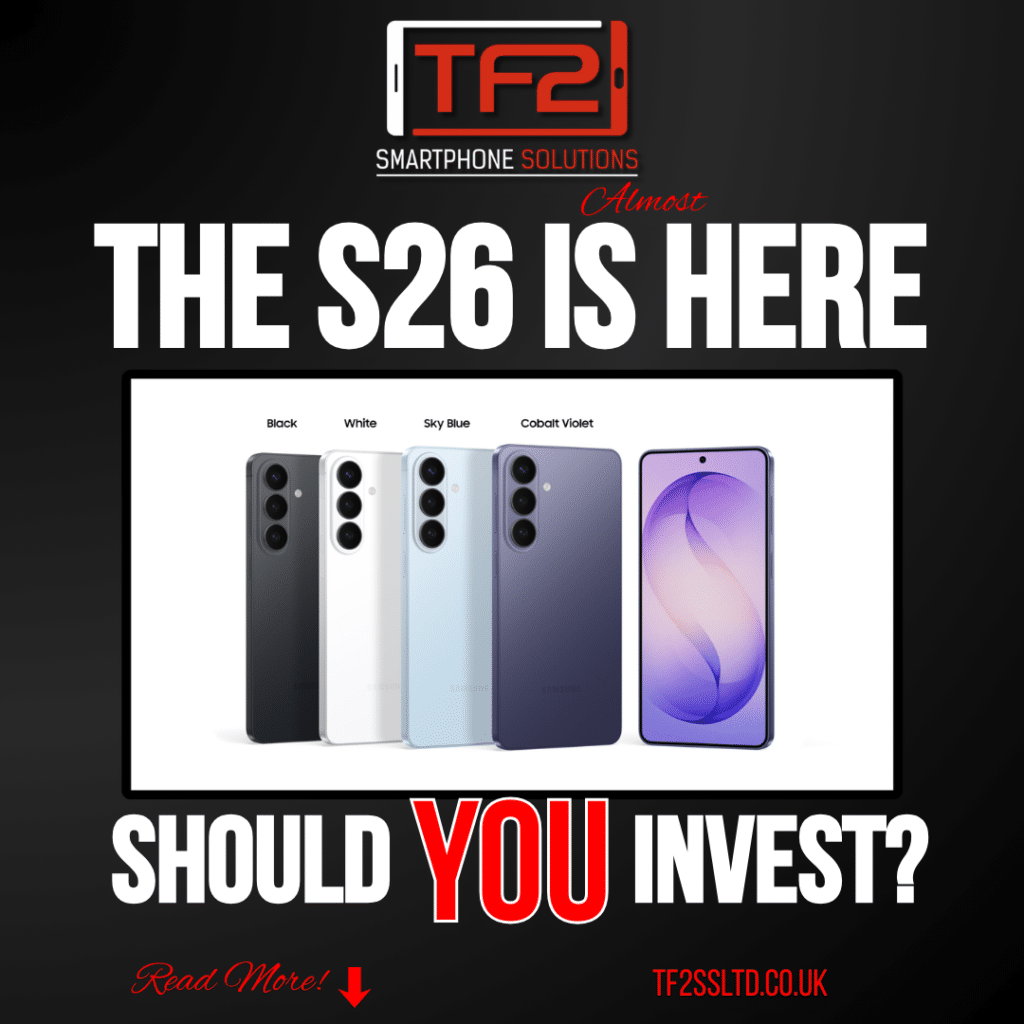
Colour options have expanded dramatically. Samsung’s offering up to 30 distinct finishes across the S26 family, with the Ultra available in Black, White, Silver Shadow, Sky Blue, Cobalt Violet, and Pink Gold, amongst others. The S26 Plus gets exclusive shades like Sunset Orange.
Software: One UI 8.5 and the AI Question
The Galaxy S26 series will launch with Android 16 as its foundation, running Samsung’s One UI 8.5 on top. The “.5” designation suggests it’s more than just a routine update—expect feature additions beyond the base One UI 8 release.
One confirmed change: Samsung’s reportedly expanding virtual assistant options beyond the current Google Gemini or Bixby limitation. Perplexity AI is the most obvious candidate for inclusion, though Samsung’s “talking to multiple vendors” according to sources.
The 12GB of RAM now standard across all models (up from 8GB in many S25 variants) specifically supports enhanced Galaxy AI capabilities. This includes improved AI Select functionality, more sophisticated Generative Edit tools, and real-time image processing enhancements.
The S26 Ultra’s camera benefits particularly from AI integration. That 24MP mode with zero shutter latency processes images in the background within approximately 3 seconds, allowing confident continuous shooting without the dreaded processing delay that plagues high-resolution modes on many smartphones.
Computational photography receives significant attention too, with improvements to portrait mode depth mapping, night photography algorithms, and—on the S26 Plus specifically—a rumoured “3X zoom HDR shooting mode” designed to enhance dynamic range when zoomed in.
What This Means for UK Buyers
So you’re in the UK, considering a Galaxy S26. What should you actually know?
🇬🇧 UK-Specific Considerations
Chip: Exynos 2600 for S26 and S26 Plus; Snapdragon 8 Elite Gen 5 for S26 Ultra
Pricing: Expected to remain stable (no price increases projected for UK market)
Availability: Full retail launch 11th March 2026
5G Support: All models feature Exynos Modem 5410 for improved power efficiency
First, accept that if you buy a standard S26 or S26 Plus, you’re almost certainly getting the Exynos 2600. Samsung’s regional split is well-established, and Europe consistently receives Exynos variants whilst the US gets Snapdragon.
The good news? This Exynos generation genuinely appears more competitive than previous iterations. The 2nm process, improved thermal management, and claimed performance gains suggest it won’t be the performance deficit disaster that some previous Exynos chips represented.
Second, pricing stability means you’re not being asked to pay significantly more for what are, admittedly, iterative improvements over the S25 generation. The S26 at £799, S26 Plus at £999, and Ultra starting around £1,100 represent fair positioning in the current market.
Third, that 11th March release date means you’ve got time. You can wait for reviews. You can see real-world Exynos 2600 performance data. You can watch early adopters discover any issues Samsung didn’t catch in testing. Patience, in this case, is genuinely valuable.
Should You Actually Upgrade?
The eternal question. Let’s break it down by current device.
If you’re on a Galaxy S25: No. Absolutely not. The improvements aren’t remotely significant enough to justify the upgrade cost. Wait for the S27 or even S28.
If you’re on a Galaxy S24: Probably not, unless you’re genuinely excited about Qi2 charging or the privacy display (Ultra only). The performance delta isn’t substantial enough.
If you’re on a Galaxy S23 or older: Now we’re talking. You’ll notice genuine improvements in display quality, battery life, camera performance, and overall system responsiveness. The jump from 60Hz to 120Hz alone (if you’re on an S23 base model or older) is transformative.
If you’re switching from iPhone or another Android brand: The S26 Ultra represents Samsung’s strongest proposition. You get the full Snapdragon experience globally, industry-leading display technology, versatile cameras, and that genuinely innovative privacy display. Just be prepared for Samsung’s occasionally overwhelming software.
The Bigger Picture: What Samsung’s Actually Doing Here
Step back from the specs and leaks for a moment. What’s Samsung actually accomplishing with the S26 series?
They’re consolidating. The death of the Edge variant and the revival of the Plus model suggests Samsung’s learnt that fragmenting their lineup with too many niche options creates confusion rather than choice.
They’re innovating selectively. The privacy display isn’t gimmicky—it addresses a genuine concern about shoulder-surfing and screen privacy in public spaces. Qi2 adoption fixes a longstanding Android wireless charging pain point. These are practical improvements rather than spec-sheet padding.
They’re playing the long game with Exynos. Samsung knows its in-house chips have reputation problems. The Exynos 2600 represents genuine technological advancement (that 2nm process is legitimately impressive), but Samsung’s being conservative about deployment, limiting